Friday, April 30, 2010

Buzzer Gets Its Color

Sunday's rattlesnake got iced.  On Monday, I carried it in an ice chest with a padded ice pack for the one-half mile trek to the relocation spot.  Cooling the snake lowers its metabolism and makes it less active during the release process.  However, as soon as I shook this snake out of the pillowcase and immobilized it with snake tongs, it started rattling.  With its head pinned to the ground, I quickly dipped its tail in green then purple ink and tossed it down the hill to its new habitat.  The ink job was messy since the rattler kept shaking its tail, but the marking was done.

 The purpose of marking the rattles is to determine if any of the relocated rattlesnakes are returning to the Dipper Ranch barn.  The good news is that so far, none of the seven rattlesnakes I have cautiously marked and relocated from 1 to 2 miles away from the barn have returned.  The bad news is that new rattlesnakes show up at the barn every year. 
 
Later in the day while I was mowing, I saw a brown-blotched snake moving in the grass.  I immediately turned off the brushcutter and stood back to observe.  After confirming with absolute certainty that the snake was a harmless gopher snake, I picked it up and carried it well out of my mowing area.  It had a big bulge midway down its body.  I hoped it was eating the pesky gophers whose mounds make it impossible to mow with a regular lawnmower.

Seeing both snakes on the same day reminded me of the key traits I use to distinguish the potentially dangerous rattlesnake from the non-venomous gopher snake.

A rattlesnake usually has rattles at the end of its tail, but the tail is not always visible.  A recently born rattlesnake will only have a button on its tail tip which does not rattle until the snake gets a second segment upon its first shedding.


A gopher snakes has a thin, pointed tail tip.  When alarmed, a gopher snake may rapidly shake its tail tip that gives the impression of a rattlesnake, especially if the tail is vibrating against leaves or the ground in a way that makes a buzzing sound.  A gopher snake may hiss when disturbed which also may sound like rattling.


A rattlesnake has a triangular-shaped head with the base of the head much wider than the neck.

A gopher snake has a narrower head which blends in more gradually with its neck.  When alarmed, a gopher snake may flatten its head which makes it look somewhat triangular.

Rattlesnake eyes have pupils which are vertical slits.  On the top of its head, a rattlesnake has many, small scales between its eyes.  As a pit viper, a rattlesnake has heat sensing pits between its eyes and nostrils which its uses to locate warm-blooded prey.
 

A gopher snake has pupils which are round or oval.  A gopher snake has a few, large scales between its eyes and does not have heat-sensing pits on its face.

Do not depend too much on body color.  The same species of snake can vary greatly in color depending on age and regional differences.  In general, I notice that a rattlesnake is often dusty looking whereas a gopher snake has a shiny coloration.

Are you ready to test yourself?  Soon I'll post more photos for you to guess whether each is a rattler or gopher snake. [Quiz now posted at Brown vs. Brown]

WARNING: Moving a rattlesnake is risky - do not attempt to relocate or otherwise handle a rattlesnake unless you know what you are doing.  I've discussed why I move rattlesnakes rather than killing or leaving them in the farmyard in The Rattlesnake Decision.  See the California Herps website for links on dealing safely with rattlesnakes and more tips on distinguishing rattlesnakes from gopher snakes.

See also:

Northern Pacific rattlesnake - Crotalus oreganus oreganus
Pacific gopher snake - Pituophis catenifer catenifer

Sunday, April 25, 2010

First Buzz

 Saw the first rattlesnake of the year on Sunday.  As the air temperature crept up to 80 degrees by early afternoon, I kept telling myself, on such a fine spring day surely the snakes will be coming out.  I was hoping to see the two shiny gopher snakes that usually show up first in the spring.  As I went about the usual weekend ranch chores, I made sure to perambulate around the barn (aka the snake pit) every now and then to look for sunning reptiles.  By the second round of barn inspections, there was a dusty head sticking out of a crack in the sliding backdoor.  I couldn't see much of the body so I couldn't tell how big it was, or check the dorsal pattern for diamonds or the tail for a rattle.  It had a somewhat triangular head and a dark line under the eye.

While peering at the snake from around the corner of the barn, I could see the numerous small scales between the eyes, but I couldn't remember whether it was gopher snakes or rattlesnakes that have that pattern.  I snuck in the front door of the barn and quietly, nervously crept to the back door to see: long fat body, diamond pattern on the back with dark rings near the tail, and a 7-segmented rattle held sideways.  Definitely a northern Pacific rattlesnake and one that had already had a few good meals after leaving its winter den.


I decided the snake's body wasn't sticking far enough out of the barn for me to easily snag it with my snake tongs, nor did I want to grab it from the inside and drag it backwards into the cluttered barn.  Instead, I set out my snake-capturing tools in the yard near the barn door and went back to the usual chores with a tingle in my shoulders.

Every 20 minutes or so, I returned to the barn to check on the rattler's location.  By the third time, the snake was slowly cruising along the outside edge of the barn door and every breeze was blowing the door back and forth over the long line of brown diamonds.  It wasn't the best angle for maneuvering, however, since I didn't want the snake to disappear, I leaned against the swinging barn door with my shoulder and snagged its tail end with the tongs.  It was a buzzer and struck at the tongs which are fortunately 3.5' long.  I dropped it into the pillowcase already pinned open in the garbage can.  A big shout and a little victory dance of relief.  Then I twisted and rubber-banded the pillow case closed, and dropped the package into the garbage can. Thunk and a buzzzzz.


I set the garbage can in the shade, and locked down the lid.  Later, when it is cool and the snake is less riled up, I will mark its rattle with calligraphy ink and relocate it far away from the farmhouse. I'll have to come up with a new color pattern to distinguish this one from the other rattlesnakes I have relocated and marked since I have already gone through my stock of 5 colors of ink.  Maybe green with a black tip for this buzzer.

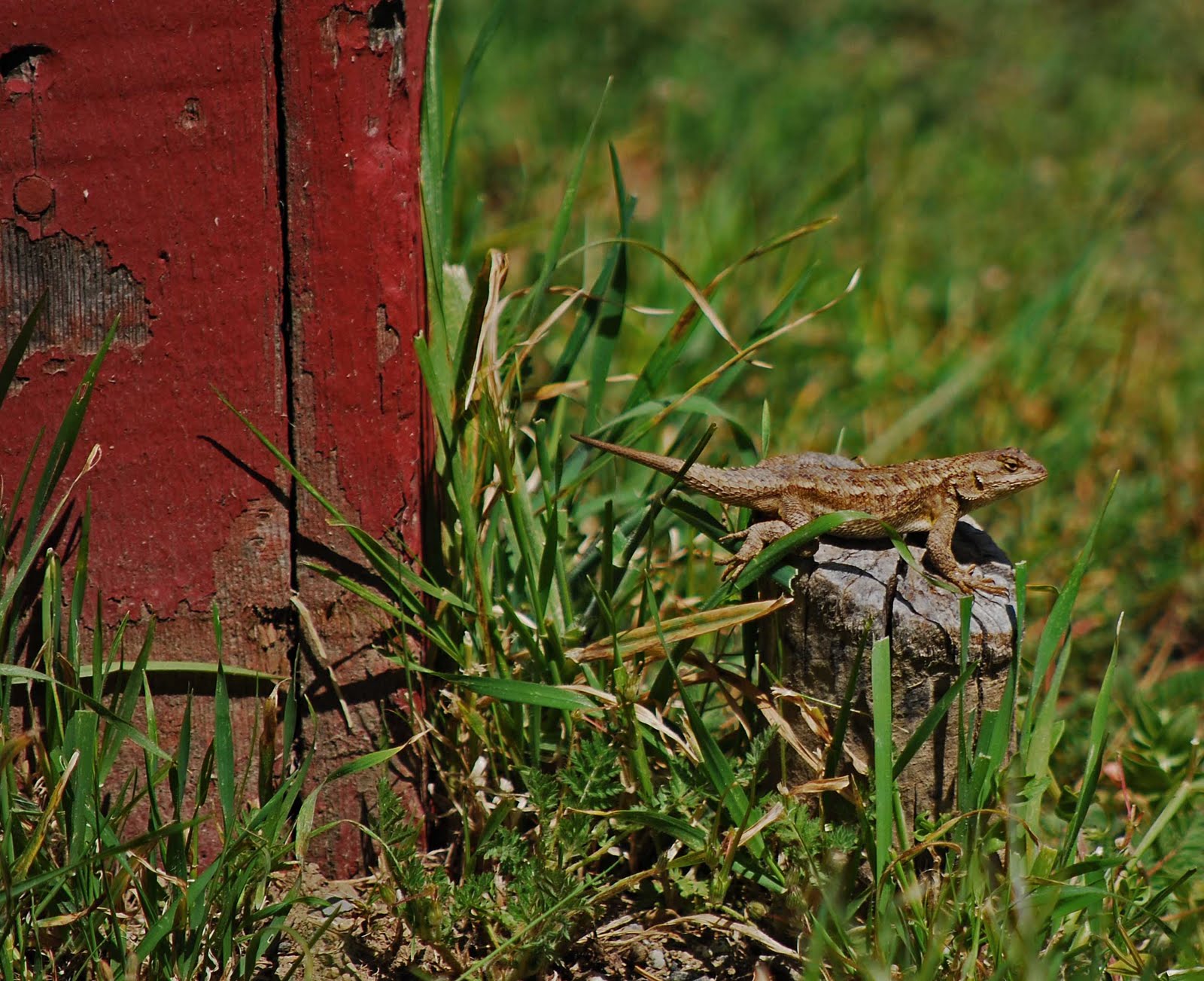
When I walked past the barn corner again, the lizards had reclaimed this snake-free corner of sun.  I'm sure I will be a little jumpy for the next few days after this first buzz of the year.


See also:
 Northern Pacific rattlesnake - Crotalus oreganus oreganus

Tuesday, April 13, 2010

A Pink Button (the inside story)

 Sky cow

To get ready for the lead paint removal on the Dipper house, I decided to move furniture out of my bedroom which is closest to where the chips tested positive for lead and also has leaky windows.  Even though the contractor promised to seal the windows during sanding, I decided to move my bed and dresser into a room without windows subject to drifting lead dust, and drape the remaining furniture with washable sheets.

A bedroom slowly falling down the mountain and cracking on the way

Once the outside of the house looked freshly painted, I suddenly decided to paint my bedroom before moving the furniture back in.  Of course, it was a greater undertaking than I expected.  The house is slowly slipping downhill in this mountain landscape and every window and door in the bedroom had at least two cracks crossing the walls, while the window with the most fabulous view leaked during heavy storms.  I am an old hand at painting, but window repair was new to me.  I consulted fix-it guides and fix-it guys, went to the hardware store several times, and struggled with conflicting advice.

By my third trip to the hardware store, I was in desperate need of some courage.  Fortunately, it was Johnny Cash's birthday and I sat in the parking lot for awhile listening to the man in black sing about brawling and prison and love on the radio.  When I finally marched into the hardware store, I insisted the clerk lend me his utility knife so I could cut a sheet of moisture- and mildew- resistant sheetrock to fit into my car.  Afterall, I told him, the other hardware store let me cut my own sheetrock (a bit of an exaggeration) and it was raining outside.  Humming "I turned 21 in prison doing life without parole", I slipped a piece of purple sheetrock onto the warehouse floor and cut it in half.

In the first part of this pink button story, I talked about ranches and legends and the signs my predecessors left outside.  The inside of the ranch house has its embellishments too:  wagon wheel lamps, a copper tile backsplash in the kitchen, and a sliding glass door that was installed backwards and until I retrofitted it, couldn't be locked.

One item left behind inside the Dipper ranch house freaked me out.  A few days after first moving in, I poked my head into the attic through the overhead hatch door in the hallway between the bedrooms.  Looking around, I saw that insulation had been added to the unfinished floor, but otherwise the space was mostly empty.  Next to the hatch opening was a heavy but loose beam.  It had a rope tied around it.  I tugged on the rope and a hangman's knot flipped up.  I realized the beam was long enough to span the hatch opening.  I must have uttered a strange noise at this discovery because my son poked his head into the hall.  He too was freaked out when he saw what I was holding at the top of the ladder.  I shoved the rope and beam back into the attic, closed it up and tried to forget about it.  One can't hang oneself in a hallway I told myself; there were some strange tenants that lived here after Paul and Lola and it must have been a prank I told my son.

A few days later, a co-worker came by to check the wiring in the house for installation of a washing machine.  The house apparently never had a washing machine, although I found an old agitating wash tub with a wringer in the garage.  Since there isn't any plumbing in the garage, I assume Lola started wash day by wheeling the tub out to the hose, the one near the kitchen door pink amaryllis. I was hoping for a more modern setup, but every time the handyman opened a fuse box or electrical outlet, he groaned at the unorthodox wiring. Finally, I told him to zip it all back up and we would have to bring in an electrician.


To mollify his disappointment at not figuring out this old house, I asked if he could help me remove something from the attic.  He thought I was talking about a dead animal.  Nope just a rope, I told him.  He held the ladder while I went back into the attic and removed the loose beam and rope.  I mostly needed his moral support to face my imagined stories about this odd artifact.  While we both joked that a hangman's knot was not quite as bad as a dead raccoon, I untied the rope, commented that it looked brand new and never used, and stashed beam and rope in separate locations in the garage for future use on more practical projects.

I was surprised at how smoothly the replacement of the mushy window jamb in my bedroom went once I got the purple sheetrock.  To counteract the lingering effect of the attic rope and to thank a legend for his encouragement, I decided to glue a photo of Johnny Cash to the inside of the jamb before sealing it down.  Someday, some other resident may find that photo, and may wonder about their strange predecessor, however, this artifact should provide humorous rather than morose musings.

Thank ya' Johnny

In addition to the climbing rose on the garage wall, there are 8 other rose bushes around the house.  In April, when the does are bedded down with their new fawns, these poor bushes recover enough from the usual deer browsing that a few of the plants even get a chance to bloom.  They are all shades of pink.  One might guess that pink was Lola's favorite color.  Or, maybe Paul thought that pink was Lola's favorite color and so every birthday and anniversary, she would graciously accept another pink flowering plant.

The sky room

I painted the bedroom sky blue.  The view looks out the backyard, down a slope towards a pasture and across a heavily forested canyon.  You feel like you are in the sky when you walk into the room.  One day while I was painting, I realized there was a cow in the backyard.  They aren't supposed to be there but since it was only one cow, I let him mow my yard while I was stuck inside patching and sanding and painting.

 A white-washed ranch house

When the painters finished the outside, I walked around for a final inspection.  There were a few bugs stuck in the paint which is to be expected at this hilltop location in the country.  I was a bit annoyed that the painters had borrowed rocks from the garden pile, perhaps to anchor down the visqueen enclosure, and had neglected to put my rocks back.  But overall, the old ranch house looks quite good.  While walking around to pick up my rocks, I found a pink button on the ground by the kitchen door.  It wasn't my button, I don't wear pink.  I don't think the pink button belonged to the painters either, especially since they wore coveralls while they worked.  If you do laundry outside with an agitating tub and a wringer, you've got to expect to lose a few buttons.  Perhaps pink really was Lola's favorite color.
 Watching a storm arrive from the sky room

Legends, we like to listen to them, we like to create them.  Adaptation is an important survival skill for ranch living, not only to the challenging physical environment, but also to the changing cultural community.  We can borrow from the good parts of our history, and set aside the useless or harmful parts.  Perhaps listening to and making up legends helps us process our history and adapt to the change that is frequently occurring around us.  I think I will tack that pink button up on the freshly painted garage wall where the chicken door used to be.

 This legend hangs on a thread

Sunday, April 11, 2010

A Pink Button

This old ranch house - not quite John-Deere green

This old ranch house got painted.  For a long time, the south and west exterior walls - the storm sides - had as much gray wood exposed as grimy white paint.  Some of the paint tested as lead, so the job got complicated.  We decided to move out of the house for a few days during the lead paint removal.  For 3 months, the family's bags and the pet crates were packed and unpacked as we waited for a few dry, windless days so the contractor could construct a temporary visqueen bubble, scrape off the remaining lead flakes, and cart them away.  Finally, in the middle of the rainy season, four projected dry days held and suddenly the job was done.

The contractor asked what color paint I preferred.  Well, the same colors, of course - white with dark green trim.  You can't change the colors of an old ranch house.

The squirrel thermometer smiles even when covered with grit on a 99-degree day.

To prepare for the painting, I took down decades of miscellaneous embellishments that had been tacked onto the walls and eaves.  The garage had a half-door contraption nailed to its exterior which at one time swung over the bottom half of the side entry.  Someone suggested it might have been used to keep chickens in the garage.  I pulled off its sagging green boards and corroded hinges, as well as two thermometers, an eagle-topped flagpole rusted and blown flat against the roof, and pulleys for some type of hanging screen long since rotted away from the porch.  Each week I worked out my annoyance over the rain delays by walking around the buildings with pry bar in hand and pulling off more random boards, nails and hooks all the while wondering who put them there and why.


Three rose bushes had tree-size trunks next to the garage.

A few years ago, a messy jungle and piles of debris surrounded the farm buildings from come-and-go tenant neglect.  We've been gradually cleaning it up.  To allow access for the painters, we needed to tackle more of the straggly plants.  I dug up and got rid of a rangy shrub next to the house to meet the defensible space requirements (clearing flammable vegetation near rural structures to reduce the potential for damage in the event of a wildfire), but I hesitated when taking my loppers after the pink rambling rose on the garage and decided to just trim it back instead.  As I pulled the tangled and decrepit vines from the wall, I discovered the live brambles were sprouting from woody stumps over a foot in diameter.  These modest-looking rose vines are actually very old plants.  I found myself trying to picture who planted them. Could I restore them to their former glory and still follow modern-day recommendations to reduce wildfire risk?


Gigantic mass of amaryllis bulbs and roots crowding the busy backdoor.

Next to the kitchen door was an amaryllis plant - the showy Hippeastrum type which are often sold as large bulbs in foil-covered pots.  Hybrids of South American origin, they are usually forced to provide colorful indoor blooms in the midst of dreary winter. At the Dipper door, this plant gets its pink trumpet blossoms in the summer, although its weather-beaten leaves never seemed to acclimate to this corner of the house.  When reaching for the hose or scrub brushes, I frequently worried I might rouse a snake hiding in its messy leaves.  I decided to transplant the amaryllis to get it out of the way of the painting and away from my backdoor cleaning center.  When I went to dig it out, I uncovered such a massive clump of roots and bulbs, I couldn't lift it out of the ground without first sawing it into smaller pieces.  Obviously, this plant had had a long residence next to the kitchen door and I wondered if I was crudely chopping into the legacy of a long ago birthday, anniversary or Easter present.  I found a sheltered spot for the amaryllis transplants in the front yard between two other old-time landscape plants, red-hot poker plants and a bed of narcissus.


The kitchen-door amaryllis bulbs sprouting at their new spot in the old yard.

Incidentally, there is another plant known as amaryllis and also pink-flowering that joins the old-fashioned landscaping at the Dipper Ranch.  A wide band of Amaryllis belladona covers the long bank between the front yard and the orchard. This African plant is commonly called Naked Ladies because months after its straplike leaves die back in the summer, bare stalks rise up like long lipstick tubes and explode with pink flowers.  I never liked the common name of this plant and used to consider it  gaudy.  I grudgingly appreciate that it is deer- and gopher-proof, and keeps out the thistles on the hardest part of the slope to mow.  One day while rereading the oral interviews with Paul and Lola Ortega, the original ranch caretakers that lived in this house, I noticed they mentioned pretty pink plants in their yard and bragged about collecting them from the former location of a hotel and stage coach stop on Page Mill Road, the stage coach road that used to cross the Dipper Ranch.  Now, I'm starting to like the Pink Ladies, as I prefer to call them, since they are the legendary booty of a stage coach heist, recycled and very practical in these rough surroundings.


Thick bed of Pink Ladies with their skirts protecting the edge of the orchard

I've heard talk about historical landscapes or historical landscaping.  Places that were planted around buildings long ago and became part of the historical culture. Some people think it is important to save and cultivate these historical landscapes along with the historical buildings to preserve the entire sense of place.  I don't pretend that the Dipper Ranch buildings have much historical significance, still I feel some responsibility to learn about and maintain the ranch's history where it is feasible and consistent with the new purpose of the ranch as an open space preserve. It is my version of thinking historically and acting locally.

The National Park Service defines historic vernacular landscape as " a landscape that evolved through use by the people whose activities or occupancy shaped it . . . the landscape reflects the physical, biological, and cultural character of everyday lives."  Estates of wealthy individuals and institutions may have fancy gardens and lawns, but the humble folk tend to create functional plantings to support their family such as orchards or vegetable gardens, or simple plantings that record a moment in their lives.

I recently found an interesting article by an architecture professor at the University of Colorado - Denver.  In Preserving Ranches: Not Only Possible, but Imperative, Ekaterini Vlahos ( I admit it, I found this an unusual name for someone researching history of the western US), talks about how "Traditional ranches are places where struggle and adaptation have etched themselves into the ground, weaving together culture, land, buildings, homes and lives."  She describes western ranches as places where people have needed to adapt to the oftentimes harsh environmental conditions, conserving their man-made and environmental resources, and often depending on the surrounding community and a local ranching economy to make it more than one generation.  In current times, as advocacy groups, recreation-based governmental agencies, and private buyers acquire traditional ranches, these new forms of ownerships often separate the ranch buildings from the land and the ranching culture.  Although I did not personally witness the transition, this discussion makes my head spin when I think about how much rural San Mateo County and its ranching history have changed over the past 60 years as the suburbs of San Francisco and Silicon Valley have expanded.

I spend most of my professional day as an ecologist trying to erase the destructive hand of man on the land - taking out erosion-prone logging roads, eliminating invasive species, and planting oaks and native grasses.  Living amongst the ghosts of the Dipper Ranch, I now sometimes get confused.  Furthermore, I think we have a tendency to wonder and make up tales about the people who lived on the land before us and we like to make legends out of them, sometimes quite exaggerated.  I am not sure why we do that.  And when and how do the new legends get started?  These are thoughts that followed me as I prepared for the ranch house painting, indeed, every time I repair, remove or alter the Dipper Ranch ground.

A Pink Button . . . to be continued

The Roessler-Rients farmstead.  In rural Minnesota, this farm has gradually changed in three generations.  I spent most summers of my childhood on this farm with my thrifty grandparents.

Tuesday, February 23, 2010

Lion About

3 legs and a tail

I saw my first mountain lion in the wild on a recent Saturday. I was home getting the house ready for painting and the phone rang about noon. It was one of the supervising rangers. A mountain lion had been reported in a tree in one of the preserves. We quickly exchanged facts. Rangers were on the way to confirm the sighting and determine a response. I reported the gut pile I found in the creek at the same preserve the day before, probably from a mountain lion kill of a deer. I agreed to meet the rangers at the preserve in 20 minutes to evaluate the situation. An advantage of living on the Dipper Ranch, the backside of one of the open space preserves, is even during off-hours the rangers can easily reach me and I can get to most of the preserves in a short period of time.

I leaned over and turned on my dispatch radio and then flew about the house grabbing my field notebook and pack. By the time I headed out the door, I heard the call come over the radio, "Animal located in tree above trail." The rangers' voices were low and their words were clipped. I thought, "This is the real thing." We get many reports of mountain lions that turn out to be bobcats, coyotes, foxes or house cats. Even when they are correctly identified, mountain lions quickly slip away in the presence of humans like tawny ghosts. Every few months, I see evidence that mountain lions live in the Santa Cruz Mountains (deer kills, tracks, large scat with scrape marks), yet they are so secretive, I had never actually seen a mountain lion roaming these hills. My hands were shaking as I unlocked the Dipper Ranch gate and I reminded myself to slow down and drive carefully on these winding country roads with weekend cyclists and beach-bound traffic.

When I got to the parking lot, I radio-ed in for permission to enter the preserve. I passed one ranger moving people out of the preserve, and he pointed me in the right direction with a few words. I knew the trail well and had just been there the day before. I turned down the volume on my radio and strained to catch sight of the rangers while keeping my steps controlled, searching the forest up and down, and calming my breath. Through the trees, I finally spotted the reflective "Ranger" tag across someone's jacket. I cleared my throat to let them know I was there and they pointed.

The day before, we discovered intestines in the creek.

Forty feet up a black oak tree, 4 large furry legs dangled to each side of a deciduous branch. Make that 3 legs and one long, fat tail. The lion was resting in speckled light with its head away from us. We could detect some slight movements of its head, but mostly, it seemed to be sleeping. We were speaking in low voices and I was fumbling between binoculars and camera. I quickly realized the nap tree was near the gut pile I had seen the day before, and it was likely the lion could see its deer carcass from its high perch. Lions usually pull the guts out of a deer and set them neatly aside before feasting on the carcass. The gut pile I had seen in a creek had probably washed down in recent rains from a deer carcass further uphill. Lions often feed on a kill, then partially bury or otherwise hide the remaining carcass for subsequent feeding over the next few days. They may stay in the area of the kill. This lion seemed to be sleeping off a meal in view of its stash, and was likely to stay in the area for a while.

Big animal napping camouflaged in tree.

We decided to continue getting all visitors out of the preserve and close it until the lion was done resting so close to a popular trail. The supervising ranger was on the radio directing other rangers to clear all trails and post warning signs. He contacted dispatch to notify adjacent park managers and communicate with the California Department of Fish and Game. Everything was going very smoothly even though we were simultaneously thrilled to see a nonthreatening mountain lion and concerned to avoid any type of human-lion conflict.

Eventually, the lion lazily raised its head and looked over its shoulder at us. It didn't seem very concerned about the small group of people way below it, watched for a few moments and then turned and rested its head pointed in the other direction. We could see its ears still on alert but the rest of the body remained relaxed. Nevertheless, we pulled out of the area to give it more room and to allow us to talk freely.

Telephoto lens - we were NOT that close.

We work with the California Department of Fish and Game to keep people safe in the outdoors but also protect the wildlife. This mountain lion was not acting aggressively towards people and was exhibiting normal behavior for a large predator (eat, sleep). In this case, because the lion was likely to stay near the assumed carcass, and that happened to be close to a busy trail, it was best to get the people out of the way to avoid any conflict. As one of the state wildlife managers frequently tells me, it is easier to talk to people than to wildlife. We decided to leave the preserve closed for the rest of the day. We would check it early the next morning, and if there were any signs of the lion or the carcass near the trail, we would keep the preserve closed. We made sure that we were following the steps outlined in our animal response protocol, had informed all relevant parties, and were clear on our assignments.

A night hike at the Driscoll ponds

Excited and relieved, I left the preserve to escort a night hike into a new preserve. That hike was about little things, frogs and newts, and it was a beautiful evening to be outside. Still, the outdoors had an edge to it after seeing a mountain lion casually occupy its territory.

The next morning, we assembled in the preserve parking lot again. A neighbor 1.5 miles away had seen a mountain lion cross through their yard near dawn. This neighbor was very familiar with wildlife and had previously seen lions, so we were confident this was an accurate report. We did not know if this was the same lion we had seen in the tree, or the other half of a pair of lions that had been irregularly reported in the general area over the past few weeks.

Alert deer at the preserve the next morning

We checked the nap tree and the lion was gone. As a group, we slowly checked all nearby trails, peering through underbrush and looking up more frequently than we are accustomed. With no signs of the lion or a carcass, we reopened the preserve later in the morning with notices posted at all trailheads that a mountain lion had recently been observed in the preserve.

I went to the field office to document the sightings and made a round of phone calls. I was fortunate to reach the person who originally reported the lion on Saturday. He had been hiking with his 5-year old son when they looked up to see what the ravens were screaming about. Without the ravens' ruckus as they harassed and scolded the lion-in-a-tree, the hikers would have never noticed the lion. The lion was lazily waving a tail or paw towards the ravens but seemed mostly intent on napping. Although intrigued, the hiker headed back to the parking lot with his son close to him. He passed and warned another pair of visitors and then called the emergency contact number posted in the parking lot. He clearly described the sighting to the dispatcher so that the rangers readily found the same location when they arrived a short time later.

I complimented the observer as he had responsibly and safely responded to the situation and quickly reported it. We discussed his son's reaction - he was excited to report his hiking adventure to his kindergarten friends. I reviewed mountain lion safety tips with them and asked that they share these with his buddies. I also directed them to the Keep Me Wild section of Fish and Game's website that gives tips on how to interact with wildlife safely and respectfully.

While I was writing up that report, the rangers called me on the radio about a mountain lion sighting at another preserve near Horseshoe Lake and in the vicinity of the dawn report. The reporting party was in the parking lot. I asked them to wait and drove 5 minutes down the road. The reporting party described seeing a cat cross a clearing between a restored oak forest and the lake, so we took a walk in that direction. She had entered the preserve a few hours earlier to observe birds for the Audubon Great Backyard Bird Count, and had noticed the bright yellow notice at the trailhead about a recent mountain lion sighting in the area. Shortly after starting her hike, she spotted a brown, long-legged cat and in her binoculars watched it saunter towards the trees. She did not see the tail but thought it was just the angle of her view. Curious, she originally hiked in the direction of the cat, but as she got into the heavy trees, she became nervous and walked around the lake in the other direction.

Over the next hour, she recorded the birds she saw in her field notebook, but did not see any further signs of the cat. When she got back to the parking lot she saw a ranger and reported her sighting. When I arrived, I listened carefully to her description, reviewed safety precautions and thanked her. As with many reports, it was impossible to tell whether she had actually seen a mountain lion or not, but we keep records because it is often the pattern of multiple reports that best reveals behavior of these furtive animals.

As she got into her car, I remembered I had photos of the dangling lion on my camera. I showed them to her hoping to elicit a response on the lion's appearance compared to her observation. She was astonished by the size of the tail in the photograph, but seemed ready to go home after her morning adventures. After she left, I wrote up a few notes and then slowly headed out of the preserve when suddenly I saw movement at the location she originally reported the cat. I immediately stopped the car and pulled out my binoculars. No question, it was a bobcat - short 3" tail, stripes and spots on its underside and the inside of its long legs, fur flaring out in the cheek area, and the typical slow, saucy walk of a 'bob'.


Over the next few days, we continued to get reports of mountain lions. This is typical whenever we post signs regarding mountain lion sightings or when the local media covers a mountain lion story. Although some of the reports were reliable (large-sized cat tracks, certain descriptions), based on our previous experience, many others were probably cases of excited misidentification. Nevertheless, we listen carefully, ask clarifying questions and keep records. As long as the sighting is brief and the animal's behavior is nonaggressive towards humans, it's a fact of interest but does not require any action.

The presence of mountain lions in the proximity of humans tends to be controversial. I've waited over a week to write about this event to give me time to think. I was excited to see the lion myself. Everyone we talked to about the event was excited too. Probably because we had photos and had witnessed a mountain lion doing mountain lion things in its own habitat. A habitat we try to share respectfully with local critters. Most of the time we only hear the predator/human conflict stories, sometimes exaggerated. It's great to have examples of lions living their lives in ways that don't threaten or upset humans.

So I decided to share this simple story of a local lion lying about. So you can be hopeful. Also, so I can share these important tips:
  • Do NOT run from a mountain lion. Running could trigger an attack response from a mountain lion. Stand tall, raise your hands above your head, throw rocks or sticks, and shout.
  • In the very unlikely event you are attacked by a mountain lion, FIGHT BACK. People have survived by punching, scratching or kicking an attacking lion. My favorite story is a biologist who was writing in her field notebook when she was attacked. She stabbed the lion in the face with her wimpy pen and it left. Lions are stealth predators. They creep up on a deer, suddenly pounce on it and between the force of their leap and their accurately placed canines severing the spine, their prey usually collapses and quickly dies. They don't expect a fight and will often leave if there is any struggle.
  • Mountain lion attacks on humans are rare. There have been no documented attacks of mountain lions on humans in the Santa Cruz Mountains since 1909. There have been 16 verified mountain lion attacks on humans in California since 1890, six of them fatal.
If Dr. Grace Augustine, the biologist in the movie Avatar, had been carrying a field notebook and writing implement, maybe her fate would have been different.

See Also:
  • Mountain Lion Foundation - As an advocacy group, they have opinions on hunting, regulations, etc. Nevertheless, the website has good information on mountain lion biology, and how to protect your pets and livestock when you live in mountain lion territory.
  • Bay Area Puma Project - researchers tracking mountain lions in the Santa Cruz Mountains. Great photos of recently collared local mountain lions.

Friday, February 12, 2010

Under Cover of Rain

I worked outside in a light drizzle most of the day. It's been raining every few days so I keep rotating between raincoats, and with my amazing boot dryer, I start each morning with toasty toes. Today, I even switched hats midday to keep my noggin dry and warm. If you dress right and there is no wind, it's pleasant and personal to travel among the mossy trees in the rain.

The saturated soil is slipping and clumping down in little piles at the bottom of hillsides and roadcuts. On Sunday, we heard a gurgling noise from above the barn. Fearing the start of a landslide, I walked up the hill to find water bubbling out of the slope. On further inspection, I realized the rains had activated a hidden spring and water was running down an old set of buried pipes to the orchard. It formed a musical fountain where it escaped a rusty section. Trees usually found on dry terrain, are reflected in unexpected mini-ponds at their bases. The earthworms leave their flooded holes and commute down wet trails.

While crossing a small creek, I realized the large swollen worm in a pool was actually a washed and tangled intestine. Seems that a mountain lion must have been feeding upstream. Mountain lions usually pull the guts out of their prey and set them in a neat pile alongside the carcass before they feed on the remaining flesh. In this dense forest, the carcass could be anywhere on the sodden slopes and the guts must have rolled into the stream.

During a brief break in today's rain, the robins puffed themselves up on bush tops and the raptors took short patrols. The deer and rabbits were out browsing midday on the forest edge as if it was dusk. A coyote came out to yap on the top of a hill where he could get a nice echo.

Under the cover of rain, we get the chance to move among the wildlife as if it is night and we are hidden. Maybe we are camouflaged by our muddy clothes. Maybe wildlife have no fear of humans who wander outside in the rain.

Tuesday, February 2, 2010

Call of the Ponds

In the frenzy of breeding, some amphibians get confused.

The frogs, toads and newts are heading to the ponds and creeks for their annual breeding. With all the rain we've been getting, these are happy herps. Now is a good time to visit ponds and creeks to witness this seasonal event.

The skewed distribution of rain in California means that some ponds and creeks are wet only in the winter and spring months. If there is rain. As a result, many California amphibians only visit the wet areas for a short period during their hectic breeding season and that is the time you are most likely to see and hear them. Not only is the water a window into their reproductive rituals, but in their frenzy to complete their duties before the rain ends, they seem less sensitive to human curiosity.

A male aquatic-phase newt shows off his black nuptial toes.

The male amphibians usually splash down first and undergo some type of physical transformation to prepare for their upcoming adventures. Male California newts develop smooth skin, swollen limbs and streamlined tails for navigating to their sweethearts in water. They get rough, black tips on their toes, called nuptial pads, to grip the female during mating.

Small in size, the male treefrog pumps a bellow below his chin so that his call can be heard from long distances by female frogs (and people too).

From every pond, creek, ditch, cattle trough and puddle at the Dipper Ranch right now, comes the chorus of male treefrogs. Their two-note (kreek-ik) call, which advertises their fitness for breeding to the female treefrogs, is mostly heard on warm nights, but also on rainy or overcast days. At the height of the breeding season, the treefrogs can't seem to resist calling even during a sunny day. The treefrog chorus will suddenly fall silent as you approach a pond's edge, but soon one frog will start trilling, and not to be outcompeted, the others will quickly join in.

Treefrogs in amplexus. As the female (bottom) releases eggs, the male releases sperm for external fertilization.

Newts in amplexus. Sometimes extra males join in.

Fertilization of eggs is facilitated by amplexus, wherein the male embraces the female from above or behind. In the newts, amplexus occurs as the pair swims slowly and gracefully together around the pond. Surely, this is one of the most peaceful rites of springs to be witnessed at the edge of a pond.

A female newt grasps pond vegetation as an egg mass emerges between her rear legs. Another newt egg mass floats in the water below her belly.

Eggs of each of the amphibian species can be distinguished by their different shapes and sizes. See links below for photos and descriptions. It's worth returning to the ponds and creeks in the next few weeks to witness the hatching of tadpoles and larvae and their transformation into tiny land-hardy frogs and newts.

So gather the family and go visit a pond or stream. Walk right up to the edge of the pond or into shallow waters and squat down to watch the aquatic play. Some activities you might try during your pond-gazing visits:
  • Can you name the different types of frogs, toads and newts?
  • Do you hear different frog calls?
  • Can you see the difference between the males and the females?
  • Can you see different types of eggs?
  • What are the amphibians eating in the pond?
For clues, see the links below for more information and photos.
Peering at you peering at him.

Names of amphibians mentioned in this posting:
  • Sierran treefrog, Pseudacris sierra - formerly called Pacific Treefrog, Pacific chorus frog, Hyla regilla or Pseudacris regilla.
  • California toad - Bufo boreas halophilus
  • California red-legged frog, Rana draytonii
  • Coast range newt, Taricha torosa torosa