Thursday, October 31, 2013

More Owl Mysteries with a Goatsucker Thrown In

In the family of "goatsuckers", I first starting seeing these small birds hunkered down on the ground at night at the Dipper Ranch after we put a thick layer of gravel on the driveway.  
After the interesting comments on the driveway owl - whether it is a great-horned owl or a western screech owl - I want to share more owl photos.  Especially a small owl that shows up at the Newt Spring and then a goatsucker that surprised me on the driveway tonight.

Those night critters.

Wednesday, October 16, 2013

Sharps at Sunset

A large buck crosses the driveway and heads down the hill at sunset.  
I am working on a post about deer at the Newt Spring in late summer and early fall. So many different deer families and they are regrouping this time of year. My notes are something likes this:

Sunday, October 13, 2013

Water for the Trickster

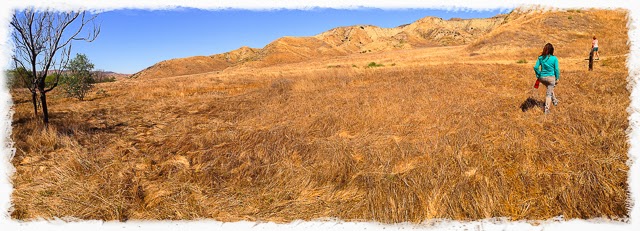
Summer-dry brown in October. That's SoCal.  
Southern California. SoCal.  Land of lovely sunshine and 13.7 inches of average annual precipitation (at Redlands).  Last year, actual annual precipitation was 9.0 inches, and so far this calendar year, there has been 3.6 inches.  Future climate models project that this region will be dry and getting drier with more extreme events including longer droughts and stronger sudden storms.

Something for us ecologists to consider when we are restoring land to natural conditions. How do we convert abandoned agricultural fields, mining pits, eroded bluffs, dissolving roads, buried or channelized creeks to diverse, functioning, sustainable natural systems? In the future climate, are these areas best suited as forests, grasslands, chaparral or ephemeral streams? With climate change, there's no going back so what is the path forward?

Friday, October 4, 2013

Arboreal and Frugivorous

Gray fox scurrying off with prey.  Are those floppy bunny ears hanging down?  
A week ago Saturday, we heard a loud crash in the backyard at 3:00 am.  People and pets raised our heads high enough to peek out the bedroom window. The backyard remained dark and silent so we went back to sleep.

Sunday, September 29, 2013

Fall Fashions at the Spring - Bold Stripes

Bold white stripes framed by a pert beanie cap on one end and a fluffy white and black tail on the other end = striped skunk  
When we were teenagers, my five sisters and I used to wait excitedly for the fall fashion edition of Vogue magazine. Like any of us ever spent $700 on a pair of pants.  Zoom forward to today at the Dipper Ranch where the boys are running around saying "Too many words!"

In the next few posts, I thought I would feature what the wildlife are wearing to the Newt Spring in the late summer and fall.

Wednesday, September 25, 2013

An Honorable Herpetologist

slender salamander  
I was sad to learn of the recent passing of the great herpetologist Robert C. Stebbins.  Long before I met him, I was fascinated with his descriptive and beautifully illustrated field guides to western amphibians and reptiles.  Matthew Bettelheim has posted information about Dr. Stebbins here and is inviting people to share their memories of him. The commentary there will be worth visiting in the next few weeks as Dr. Stebbins encouraged so many people to discover the fascinating world of reptiles and amphibians.  My thanks to his family, colleagues and friends for sharing Dr. Stebbins and his legacy.

Tonight, I think I will share some photos of my favorite times with California herps to say my goodbye. So many scaly and slimy adventures of learning and delight.

Sunday, September 22, 2013

Thinking Backwards: the Landscape

Not much grows on a scree slope
Photo by randomtruth.  
Part 3: are you still with me? Still thinking backwards? This is my favorite part - the landscape state of mind. You are crossing a natural area, hyper-alert but at the same time in a dreamlike trance since you are not task-oriented, just absorbing as much of your surroundings as possible. Collecting images, sounds, and maybe a little scent. As an ecologist, I'm looking for clues on how the pieces fit together. This natural area is not just a list of plants and animals, but a constant flow of energy with any little click being some type of adjustment between the animate and inanimate. Even if I don't recognize these ecological relationships at the moment, my observations might help figure out patterns of the place later.

Every day in our wildlife camera trapping workshop at the Sierra Nevada Field Campus, we ventured into the beautiful montane landscape of Yuba Pass to practice our skills in a new environment. One morning, workshop instructor Dr. Chris Wemmer led the class across the North Yuba River in search of the bushy-tailed woodrat (Neotoma cinerea). But first we had to climb the side of a mountain.